Daniel Rui
Hello, dear visitor! Here lies my little château numérique at road's end -- please do enjoy your stay! If you want to read more about me, you can visit the About me page.
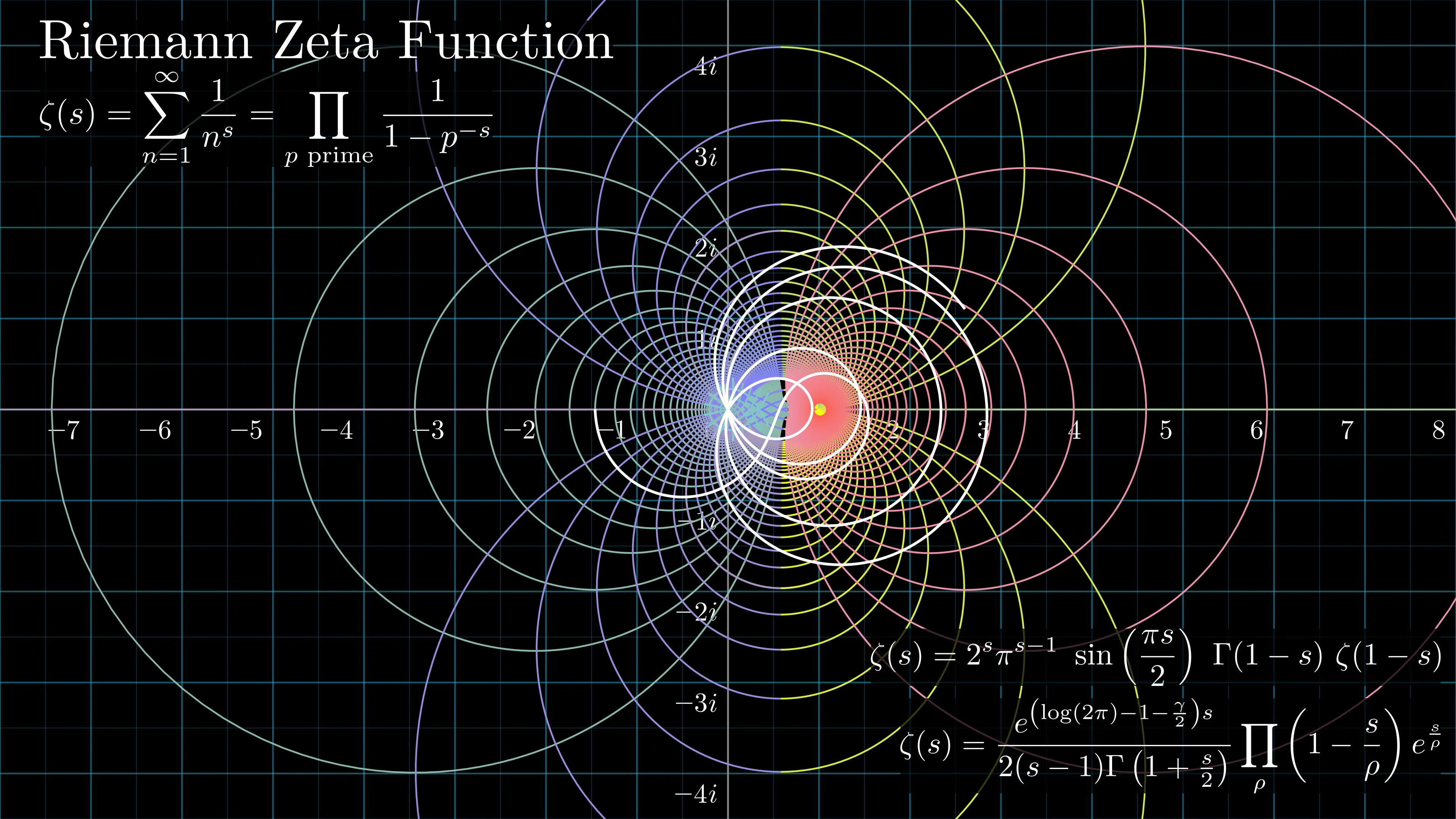
All my (somewhat presentable) mathematical work is on the Publications page (complete repository in papers subfolder), and Tiny-Daniel™ videos and other piano paraphernalia are on the Music tab. If you want to view all my old math work, take a trip down to the Archive -- keep in mind though that all of those I wrote in high school, so the quality may be unbounded in the negative direction. Should you want to contact me for whatever reason, just send me an email at danrui@ucla.edu. Oh, and before you go, here are some cool visualizations, e.g. the Riemann zeta function courtesy of 3B1B, and then some quotes!
All my (somewhat presentable) mathematical work is on the Publications page (complete repository in papers subfolder), and Tiny-Daniel™ videos and other piano paraphernalia are on the Music tab. If you want to view all my old math work, take a trip down to the Archive -- keep in mind though that all of those I wrote in high school, so the quality may be unbounded in the negative direction. Should you want to contact me for whatever reason, just send me an email at danrui@ucla.edu. Oh, and before you go, here are some cool visualizations, e.g. the Riemann zeta function courtesy of 3B1B, and then some quotes!
Some HTML/Javascript (OneCompiler) applets that I created with the help of some LLMs (or rather more accurately, that some LLMs created with my help). The most surprising one is Brownian motion via coin flips, using Marchal's algorithm for strongly convergent sequences of simple random walks.
Some quotes that may be of interest:
『三人行,必有我師焉。擇其善者而從之,其不善者而改之。』- 《論語·述而第七【廿一章】》 My translation: 『Walking in a group of three, always there will be a teacher for me: I select therein the one enbodying any (given) virtuous quality to follow from, and the one enbodying any (given) unvirtuous quality to correct from.』or 『Walking in a group of three, always there will be a teacher for me: I select therein (for any given virtuous quality) the one enbodying most that quality to follow from, and the one enbodying least that quality to correct from.』
『If you look for the light, you can often find it... but if you look for the dark, that is all you will ever see.』- Uncle Iroh
『It is hard to exaggerate the importance of the effect on the history of science produced by this great success of the theory of gravitation. Compare the confusion, the lack of confidence, the incomplete knowledge that prevailed in the earlier ages, when there were endless debates and paradoxes, with the clarity and simplicity of this law—this fact that all the moons and planets and stars have such a simple rule to govern them, and further that man could understand it and deduce how the planets should move! This is the reason for the success of the sciences in following years, for it gave hope that the other phenomena of the world might also have such beautifully simple laws.』- Feynman Lecture 7. Indeed... the sheer audacity to believe that the humble apple, and the empyrean moon, should both oblige the same law! And to be correct! ...Though perhaps I should trace this back to Euclid, who had the even greater audacity to subsume all known geometry of that time, and indeed of every time, under the stewardship of just five postulates [essentially; cf. Hilbert]. Imagine, being a master geometer, a connoisseur of angles and lines and circles, a knower of all these facts, and someone comes along and says "Ah, I can deduce all that you know, all that your children and your children's children and so on will ever know about angles and lines and circles, just from these five simple assertions". I would laugh, and laugh, and laugh. And yet here we are... Somehow the root of our mathematical tree is but the width of two human hands. I often think about the fact that this observation was made only once independently in recorded human history --- (the notion of) writing was invented independently at least 3 times for sure (in the Near East, China, and Mesoamerica), but the idea that a single slip of text could hold up the entire logical universe, only once (in Ancient Greece). How indebted we are to our forerunners! What a gorgeous view they have given us, atop their mighty shoulders.
『When we try to pick out anything by itself, we find that it is bound fast by a thousand invisible cords that cannot be broken, to everything in the universe.』- John Muir in his journal July 27, 1869
『Some of you will be successful, and such will need but little philosophy to take them home in cheerful spirits; others will be disappointed, and will be in a less happy mood. To such, let it be said, "Lay it not too much to heart." Let them adopt the maxim, "Better luck next time;" and then, by renewed exertion, make that better luck for themselves.
And by the successful, and the unsuccessful, let it be remembered, that while occasions like the present, bring their sober and durable benefits, the exultations and mortifictions of them, are but temporary; that the victor shall soon be the vanquished, if he relax in his exertion; and that the vanquished this year, may be victor the next, in spite of all competition.
It is said an Eastern monarch once charged his wise men to invent him a sentence, to be ever in view, and which should be true and appropriate in all times and situations. They presented him the words: "And this, too, shall pass..." How much it expresses! How chastening in the hour of pride! -- how consoling in the depths of affliction! "And this, too, shall pass..." And yet let us hope it is not quite true. Let us hope, rather, that by the best cultivation of the physical world, beneath and around us; and the intellectual and moral world within us, we shall secure an individual, social, and political prosperity and happiness, whose course shall be onward and upward, and which, while the earth endures, shall not pass away.』- Abraham Lincoln's elaboration (in a speech given before the Wisconsin State Agricultural Society on Sep. 30, 1859 in Milwaukee, WI) on a famous story from a 12th century poem by Sufi apothecary-poet Farid ud-Din Attar [Ilāhī-Nāma Discourse XV (7) Story of the king and the ring.]
『The mathematician’s patterns, like the painter’s or the poet’s must be beautiful; the ideas like the colours or the words, must fit together in a harmonious way. Beauty is the first test: there is no permanent place in the world for ugly mathematics.』- G. H. Hardy
『Music is the pleasure the human mind experiences from counting without being aware that it is counting.』- Gottfried Leibniz
『Mathematics, rightly viewed, possesses not only truth, but supreme beauty-a beauty cold and austere ... yet sublimely pure and capable of stern perfection such as only the greatest art can show.』- Bertrand Russell
『Whatever you can do, or dream you can, begin it. Boldness has genius, power and magic in it.』- Johann Wolfgang von Goethe
『Combinatorics is an honest subject.』- Gian-Carlo Rota
『When a man knows he is to be hanged in a fortnight, it concentrates his mind wonderfully.』- Samuel Johnson
『If you want to really hurt your parents, and you don't have the nerve to be gay, the least you can do is go into the arts. I'm not kidding. The arts are not a way to make a living. They are a very human way of making life more bearable. Practicing an art, no matter how well or badly, is a way to make your soul grow, for heaven's sake. Sing in the shower. Dance to the radio. Tell stories. Write a poem to a friend, even a lousy poem. Do it as well as you possible can. You will get an enormous reward. You will have created something.』- Kurt Vonnegut, in A Man Without a Country
『It was played in New York, Philadelphia, Chicago, etc. At the first two performances I was present. It was played wonderfully. Its reception by both the public and critics was sour. One review sticks painfully in my mind: that I didn't have a Third Symphony in me any more. Personally, I am firmly convinced that this is a good work. But—sometimes composers are mistaken too! Be that as it may, I am holding to my opinion so far.』- Sergei Rachmaninoff, on his 3rd Symphony in a 1937 letter
『If people do not believe that mathematics is simple, it is only because they do not realize how complicated life is.』- John von Neumann, from a 1947 ACM keynote
『Do I contradict myself?
Very well then I contradict myself,
(I am large, I contain multitudes.)』- Walt Whitman, in Leaves of Grass
『The question you raise, "how can such a formulation lead to computations?" doesn't bother me in the least! Throughout my whole life as a mathematician, the possibility of making explicit, elegant computations has always come out by itself, as a byproduct of a thorough conceptual understanding of what was going on. Thus I never bothered about whether what would come out would be suitable for this or that, but just tried to understand - and it always turned out that understanding was all that mattered.』- Alexander Grothendieck, in a 1983 letter to Ronnie Brown
『Last time, I asked: "What does mathematics mean to you?" And some people answered: "The manipulation of numbers, the manipulation of structures." And if I had asked what music means to you, would you have answered: "The manipulation of notes?"』- Serge Lang, in The Beauty of Doing Mathematics: Three Public Dialogues
『The price of metaphor is eternal vigilance.』- Norbert Wiener
『Why are numbers beautiful? It's like asking why is Beethoven's Ninth Symphony beautiful. If you don't see why, someone can't tell you. I know numbers are beautiful. If they aren't beautiful, nothing is.』- Paul Erdős
『To cease to wonder is to fall plumb-down from the childlike to the commonplace --- the most undivine of all moods intellectual. Our nature can never be at home among things that are not wonderful to us.』- George MacDonald
『The most beautiful thing we can experience is the mysterious. It is the source of all true art and science. He to whom this emotion is a stranger, who can no longer pause to wonder and stand rapt in awe, is as good as dead: his eyes are closed.』- Albert Einstein, in Living Philosophies, 1931 . . . . . . . . . . 『This mystery makes life eternally livable.』- Brian Zahnd
『We have not succeeded in answering all our problems. The answers we have found only serve to raise a whole set of new questions. In some ways we feel we are as confused as ever, but we believe we are confused on a higher level and about more important things.』- anonymous quote from Bernt Øksendal's Stochastic Differential Equations
『Mathematics has been called the science of the infinite. Indeed, the mathematician invents finite constructions by which questions are decided that by their very nature refer to the infinite. That is his glory. Kierkegaard once said religion deals with what concerns man unconditionally. In contrast (but with equal exaggeration) one may say that mathematics deals with the things which are of no concern to man at all. Mathematics has the inhuman quality of starlight, brilliant and sharp, but cold. But it seems an irony of creation that man’s mind knows how to handle things the better the farther removed they are from the center of his existence. Thus we are cleverest where knowledge matters least.』- "one of [Hermann] Weyl’s last, bittersweet observations on mathematics", 1985
『The constructs of the mathematical mind are at the same time free and necessary. The individual mathematician feels free to define his notions and set up his axioms as he pleases. But the question is will he get his fellow mathematician interested in the constructs of his imagination. We cannot help the feeling that certain mathematical structures which have evolved through the combined efforts of the mathematical community bear the stamp of a necessity not affected by the accidents of their historical birth. Everybody who looks at the spectacle of modern algebra will be struck by this complementarity of freedom and necessity.』- Hermann Weyl, 1951
『My work has always tried to unite the true with the beautiful and when I had to choose one or the other, I usually chose the beautiful.』- Hermann Weyl, 1956
『Я скажу Вам про себя, что я — дитя века, дитя неверия и сомнения до сих пор и даже (я знаю это) до гробовой крышки. Каких страшных мучений стоила и стоит мне теперь эта жажда верить, которая тем сильнее в душе моей, чем более во мне доводов противных.
И, однако же, Бог посылает мне иногда минуты, в которые я совершенно спокоен; в эти минуты я люблю и нахожу, что другими любим, и в такие-то минуты я сложил в себе символ веры, в котором всё для меня ясно и свято.
Этот символ очень прост, вот он: верить, что нет ничего прекраснее, глубже, симпатичнее, разумнее, мужественнее и совершеннее Христа, и не только нет, но с ревнивою любовью говорю себе, что и не может быть. Мало того, если б кто мне доказал, что Христос вне истины, и действительно было бы, что истина вне Христа, то мне лучше хотелось бы оставаться со Христом, нежели с истиной』- Fyodor Dostoevsky
『Ich bin der Welt abhanden gekommen,
Mit der ich sonst viele Zeit verdorben,
Sie hat so lange nichts von mir vernommen,
Sie mag wohl glauben, ich sei gestorben!
Es ist mir auch gar nichts daran gelegen,
Ob sie mich für gestorben hält,
Ich kann auch gar nichts sagen dagegen,
Denn wirklich bin ich gestorben der Welt.
Ich bin gestorben dem Weltgetümmel,
Und ruh’ in einem stillen Gebiet!
Ich leb’ allein in meinem Himmel,
In meinem Lieben, in meinem Lied!』- Friedrich Rückert, set to music by Gustav Mahler
『Здесь хорошо...
Взгляни, вдали
Огнём горит река;
Цветным ковром луга легли,
Белеют облака.
Здесь нет людей...
Здесь тишина...
Здесь только Бог да я.
Цветы, да старая сосна,
Да ты, мечта моя!』- Glafira Adol'fovna Galina, set to music by Sergei Rachmaninoff (Op. 21, No. 7 it's good here)